





In the modern era of education, students and teachers are more connected globally than ever before, making internationalisation a key driver in Vocational Education and Training (VET).
Following the COVID-19 crisis, the European Commission promoted virtual mobility and, in 2021, officially introduced blended mobility in the new Erasmus Plus Guidelines, defining it as: “Any study period or traineeship abroad of any duration may be carried out as a blended mobility. Blended mobility is a combination of physical mobility with a virtual component facilitating a collaborative online learning exchange and teamwork“.
Within this framework, one of the main aims of the Developing Capacity for VET Systems in Western Balkans (DC-VET WB) Erasmus+ project is to boost internationalisation strategies of VET schools across the Western Balkans.
To achieve this objective, this capacity building project, involving seven partners organisations from Albania, Bosnia and Herzegovina, Finland, Italy, Kosovo, Spain and Montenegro, developed an E-learning course on internationalisation for VET staff which has been tested among Western Balkans VET schools.
Meanwhile, DC-VET WB partners identified seven VET schools to be involved in piloting of three blended mobility projects focused on relevant and common topics:
- IT & automation
- Green energies
- Transversal skills
The implementation of the experimental mobilities took place from November 2024 until May 2025 with five days of physical mobility in Albania with two students and an accompanying person from each country for the finalisation of their blended project from the 15th to the 19th of September 2025.
These step-by-step guidelines capture these three experiences, offering concrete insights and practical recommendations with the objective of inspiring and supporting other VET schools in developing and implementing their own blended mobility initiatives in the future.
The first step in setting up the blended mobility projects is to define the thematic area/s which are relevant to the study field of your VET school and fitting well in their curricula.
Once the thematic area is defined, the next step is to find the most suitable VET school/s that share the same or similar interest to that area and identify the leading teacher(s). In order to share your idea with other teachers, we suggest:
- To create online folder containing search documents in which you describe the thematic area you would like to focus on and your idea of project
- To organise bilateral meetings with the lead teacher of the other school/s to discuss their point of view on the topic and agree on the perimeter of your project in terms of thematic areas, problems to be tackled and objectives.
In this step it is essential to be open to the perspectives of other schools, your project idea should be focused but flexible enough to include the needs of the other organisation/s. This is crucial to ensure the commitment of all parties involved.
In the DC VET project, schools reflected on the possible topics for joint work and identified three common thematic areas: electronics, sustainable energy, automation, IT and transversal skills/key competences. Blended mobility projects can be applied to all study fields according to different VET sectors and priorities, such as health and social care, agriculture and food technology, tourism and hospitality, construction, media and communication, design and fashion, or entrepreneurship and digitalisation.
| Good practice from DC VET project
Thematic areas defined by each group of schools involved in DC VET. |
|
|---|---|
| Thematic area | Countries involved |
|
|
|
|
|
|
Checklist
According to the defined objectives and expected final outputs, the collaborating schools design the specific activities to be implemented offline (at school or in other local context) and online (with the partner school/s) in a coherent path for students involved. To coordinate this process, it is recommended to organise one or more meetings between the teachers involved to:
- translate project objectives into concrete offline and online activities by creating a programme including a short description for each of them;
- define roles and responsibilities within each school for the different activities exchange contacts and identify communication protocols;
- agree on timeline and common dates for the online sessions and physical activities.
Carefully choose when and how to mix the two components of a blended mobility project: the online and physical parts. There could be 3 main set-ups for a project with one single physical mobility:
Option 1: Start with the physical mobility to launch the project and continue the work through online meetings organised afterward.
Option 2: Organise the physical mobility in the middle of your projects, with online sessions before and after. This will allow students to prepare with preliminary activities before the physical meeting, strengthen the collaboration during the mobility and finalise the work with a last session of online meetings.
Option 3: Organise the physical mobility at the end of the project. This setting gives you more time to work with the students through online sessions and build up a relationship between them. The physical mobility at the end is an event to show the results, draw conclusions and finalise the activities.
| Good practice from DC VET project
According to the three pilot blended mobilities, the average of online activities is 4 meetings in total, but it is important to remark that there’s no minimum or a maximum of online meetings with students. This is up to teachers’ and project needs. In the group working on transversal skills, the schools agreed on a series of online sessions with a different facilitator following this structure:
|
Challenges and tips:
- Timetable: aligning timetables among different schools can be challenging. Due to this reason, while implementing the project, the above mentioned group met online three times instead of four. For this reason, it is recommended to agree on dates from the very beginning, using tools like Doodle to coordinate availability. Flexibility is also necessary, as school calendars may include internship weeks or other unexpected activities that require rescheduling.
- A pre-activity questionnaire can be prepared and shared with the students in this phase to verify students’ expectations. Here the google form used from Automation / IT group.
Checklist:
Now that the framework of the blended mobility project is traced, it is time to reflect on practical aspects such as defining which class and how many students will be involved in the activities. The numbers of participants involved can vary depending on the scope of planned project activities and the resources available (for mobility). In some cases, projects can include participation of entire classes or delegations of students. Other factors should also be considered at this stage: for example, if the physical mobility takes place in the following academic year, students of the final-year should not be involved.
It is also important to set up communication channels and tools: the most common ones are regular emails and a shared Google Drive folder, but other ones can be used according to school preferences. The E-Twinning platform, now converged into the European School Education platform, remains one valuable asset in the hands of schools to structure their blended projects. Most importantly define the online communication platform that you will use, for example: Zoom, Google Meet, Teams etc.
Furthermore, establish what kind of material you will need and also if such material must be available in all schools to successfully carry out the activities. The more your project will be focused on technological subjects or stems, the higher the probability that pieces of equipment will be needed.
| Good practice from DC VET project
For each blended mobility project a specific folder in Google Drive was created to: upload working material (presentation and pictures). Blended Mobility Journal: this document allows VET schools to keep track of blended mobility project progress, by adding a short the name of activity, the status (done, in progress or not done), if the activity was online or offline, a description and related link or picture. The document is divided in four parts concerning the planning phase, online collaboration, physical mobility and evaluation). At the end of the step-by-step guidelines a template is available. One group also created a Google Classroom space to better coordinate students and teachers. Regarding material, the groups IT/automation and green energy used a bike, laptops, solar panels, cables, a dynamo, an Arduino R4 WiFi board and a DHT11 sensor. |
Challenges and tips
- Equipment: it can happen that some materials are not available in both schools. For example, in the Renewable energy group, a common activity was not feasible due to the lack of photovoltaic panels in Bosnian schools. This challenge was resolved by agreeing on carry out complementary activities under the shared topic Green energies in VET schools:
– creating photovoltaic solar panel in the Spanish school;
– building bicycle generators in Bosnian school;
– carrying out a solar research activity on the Bosnian school roofs.
- Language barrier: it is advisable to require a minimum English level of B1 for participating students and teachers to ensure smooth communication and active participation during both online and physical activities. If not possible, a colleague with a good English level has to support by translating in the mother language.
- Staff change: it may happen that the lead teacher can’t follow the blended mobility project for the whole period due to overload and other school commitments. In such cases, it is recommended to appoint another teacher with more availability and ensure they receive all necessary information, including access to the Blended Mobility Journal, to maintain continuity of the project.
Checklist:
The virtual (online) component is the central element of blended mobility and can take place before, during, or after the physical mobility, depending on the pathway designed in Step 3. To ensure a smooth and meaningful online learning experience you can combine synchronous and asynchronous activities to maintain flexibility and engagement.
Examples of synchronous activities:
- Ice-breakers and team-building games to create trust among students;
- Virtual lessons to introduce or explore project topics together;
- Group discussions and debates with teachers or external experts;
- Collaborative tasks in mixed-nationality teams;
- Regular check-in meetings to monitor progress and support students;
- Development of prototypes;
- Creation of joint presentations.
At the end of each online session it is recommended to organise a wrap-up to summarise what was done and give assignment of the following sessions. Also, collect feedback from students to improve the next working sessions. Feedback can include questions on the overall impression, what students learned and what can be improved.
Asynchronous activities (self-paced tasks) can be used to deepen the work and prepare for the following synchronous session together with the other students. Some examples of activities:
- Watching recorded lessons or tutorials, including videos made from students of the other school/s as part of the learning project;
- Completing research tasks or assignments that will be shared later online;
- Uploading assignments or project work carried out locally (for example a description on the town/city where the school is located to be shared with the other school/s;
- Using collaborative tools (e.g. shared documents, digital boards, project management apps).
The role of teachers
In this phase, teachers from different countries should plan the activities jointly, and introduce the working session with lectures/presentations when needed. Most importantly the role of teachers is to facilitate the interaction among students from different countries who can be hindered by the online tool and the language barrier. Also teachers should be ready to solve technical issues, find alternatives in case of problems and provide constructive feedback.
Finally, after the activities the teachers should summarise the results and keep track of the activities on the dedicated tools such as the blended mobility journal or other digital instruments (e.g. e-Twinning platform, google classroom etc.).
| Good practice from DC VET project
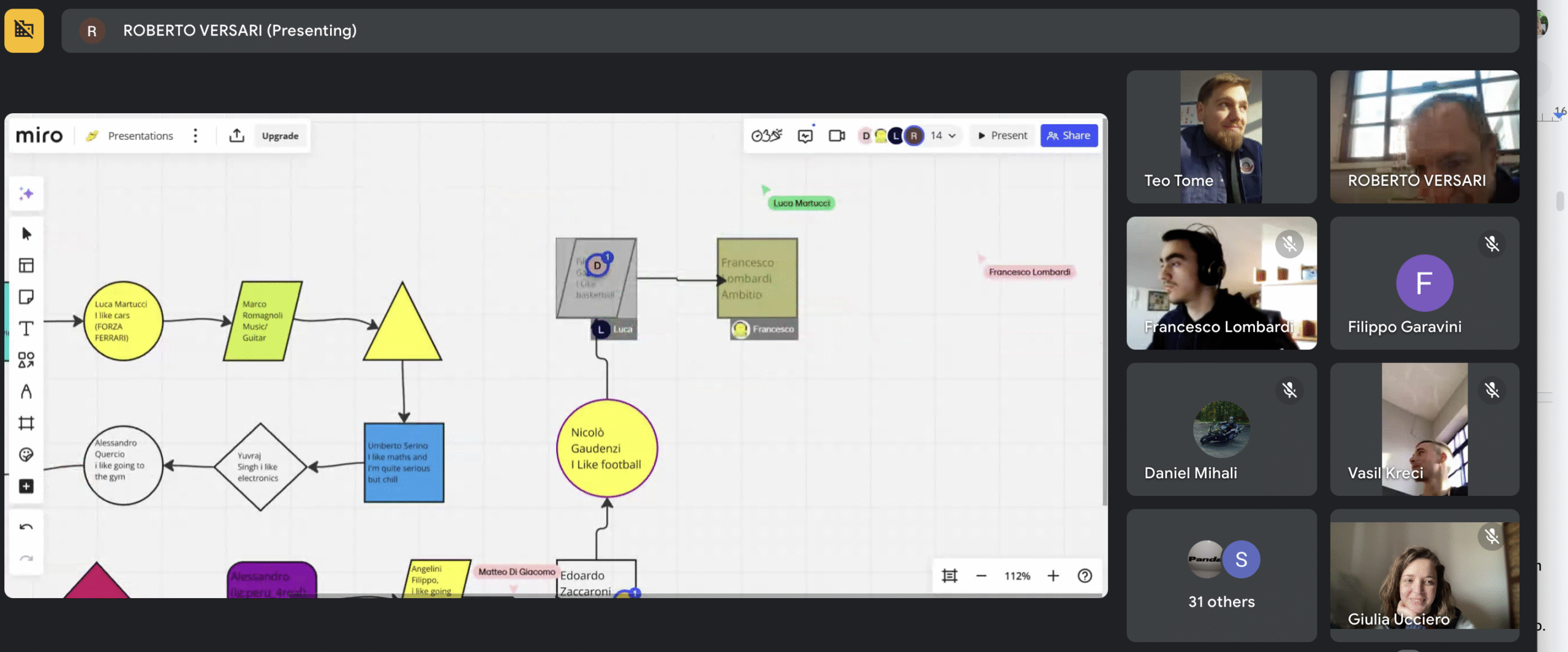
For the icebreak activity, the automation group used a Miro board where each student could present themself by writing their name and some hobbies or key features
|
Challenges and tips
- Collaboration between students from different countries: collaborating virtually can be challenging, as it is harder for students to get to know each other and build a climate of trust. For this reason, it is highly recommended to use interactive tools during online meetings: a group, for example, used a Kahoot quiz on MQTT and IoT system to verify students’ progress and at the same time to create a playful environment.
- Internet and technical problems: technical issues, such as unstable internet connections or malfunctioning microphones, can occur during online sessions. To prevent this, it is advisable to check microphone settings and internet connectivity during teachers’ meetings before starting the student activities.
Checklist:
When preparing the physical mobility, which can be scheduled before, during, or after the online activities, depending on the blended mobility path designed in Step 3, it is important to follow these steps:
- The hosting school shares an infokit with practical information (accommodation, transport options and local contacts) and a registration form;
- A pre-departure online meeting is organised with all participants to present the draft agenda, review the infokit, and collect registration details;
- Each school involved in the project takes care of logistics, such as purchasing flight or bus tickets and booking accommodation, in line with the project budget;
- If necessary, prepare the Erasmus+ documents (for example Learning Agreement and Mobility Agreement);
- Teachers finalise the agenda and related activities.
During the physical mobility, a wide range of activities can be organised, such as:
- Ice breaking activity
- Theoretical lessons to deepen the chosen topic;
- Practical workshops to complete or extend the online activities;
- Student presentations to share the results of their collaborative work;
- Company visits and study visits to connect learning with the labour market;
- Hands-on lab activities in school facilities;
- Cultural visits and team-building activities to strengthen relationships among participants.
The final day of physical mobility should focus on summarising all activities and results. To provide formal recognition of participants’ engagement, achievements and acquired skills, it is recommended to organise a certificate ceremony. This event acknowledges participants’ commitment and enhances the overall visibility of the project. Additionally, a follow-up feedback form should be prepared in advance to help understand what worked well and identify areas for improvement in future projects.
| Good practice from DC VET project
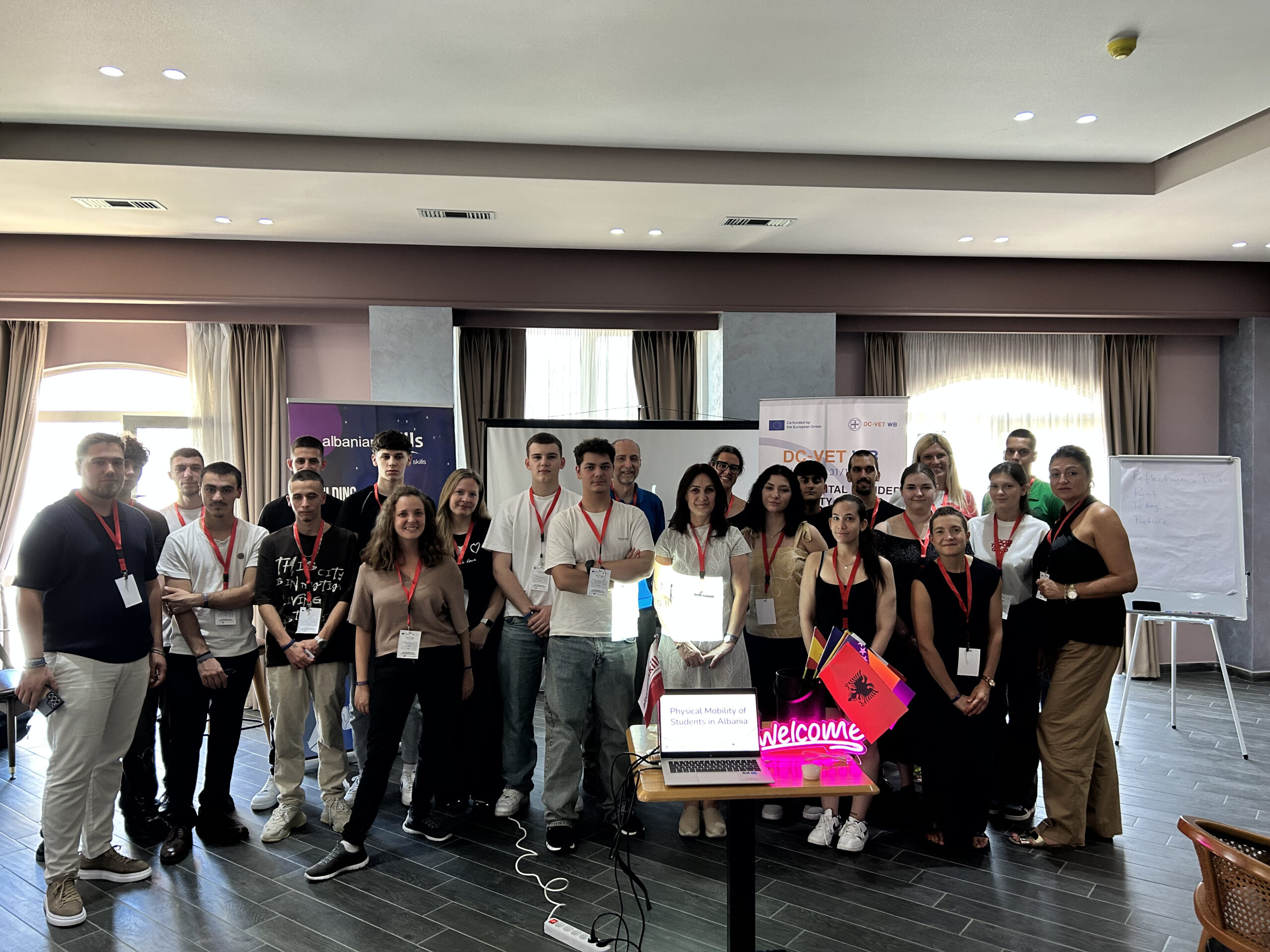
The physical mobility in Albania combined academic, collaborative, and cultural activities: During the first day, students took part in the ice-breaking activity “Human Bingo on key competences”, which they found particularly engaging, as it allowed them to learn interesting facts about one another. Afterwards, the groups finalised and presented their joint projects, showcasing different ideas and approaches. In the evening, a cultural night was organised, where each country shared its traditions and performed typical songs and dances. On the second day students were divided into mixed groups to develop new business ideas and draft simple business plans using a template. The activity concluded with a pitch presentation to other groups, strengthening entrepreneurial and transversal skills. A cultural visit to Durrës city centre followed, including historical monuments and points of interest. On the last day, final presentation of the blended mobility outcomes at Europe House in Tirana, followed by a certificate ceremony. The programme ended with a cultural tour of Tirana city centre.
|
Checklist:
A blended mobility project does not end with the physical exchange. It is important to bring the experience back into the classroom through activities that focus on reflection of what has been learned during the weeks of implementation. Students can present the activities carried out and share impressions on the learning experience back home to their peers. This should also be the phase when mobility is formally recognised within the school system, for example by assigning grades to students, extra-curricular recognition, or digital badges/micro-credentials that certify students’ new competences. At the same time the teachers who participated in the project can have debriefing sessions to evaluate strengths and weaknesses of the project. This can be done at local level, among the teachers from the same school but also at transnational level, with colleagues from the partner school/s. The results achieved can spark new ideas for future projects.
| Good practice from DC VET project
In Italy, after the restitution meeting, students received a grade in the subject Sistemi Automatici, the activity was added to their portfolio and CV in the UNICA platform (relevant for the final exam), and it was formally recognised as a PCTO extra-curricular activity. Finally, analysing questionnaires and conducting an internal self-assessment provides a basis for future initiatives, such as developing new activities with the same schools, expanding collaboration to new partners, or exploring different subject areas. |
Checklist:
The pilot experiences carried out within the DC VET project clearly demonstrate how blended mobility can enrich VET schools by integrating classroom learning with digital tools and international cooperation.
One of the strengths of the blended mobility format is its flexibility: projects can be adapted to different VET sectors, school priorities and schedules. From this experience it was highlighted that a few hours spent together in person can be worth several online sessions, underlining the importance of combining both dimensions effectively.
Teachers agreed that blended mobility projects have a deep impact on students’ learning and growth. One teacher reflected that: “It was inspiring to collaborate with people from different cultural and educational backgrounds, to see how diverse perspectives could come together to solve problems, share knowledge, and create new ideas.” From the students’ perspective, the mobilities were described as rewarding, inspiring and fun: they improved competences, encouraged intercultural exchange and created lasting memories. As one student wrote: “I will encourage others to participate in projects like this if they get an opportunity because it was a good experience and I learned a lot (…). I would definitely do this again.”
These results confirm that blended mobility is not only a response to the challenges of recent years, but a sustainable and innovative approach to internationalisation. By combining digital and physical activities, schools can increase inclusiveness and extend international opportunities and competences to a wider group of learners and teachers.
| GOOD PRACTICE FROM DC VET PROJECT
If you would like to use the template piloted in DC VET project, you can download it here: Blended Mobility Journal Template. Finally, here you can see all the steps and activities carried out from the 3 pilot groups: |
In the modern era of education, students and teachers are more connected globally than ever before, making internationalisation a key driver in Vocational Education and Training (VET).
Following the COVID-19 crisis, the European Commission promoted virtual mobility and, in 2021, officially introduced blended mobility in the new Erasmus Plus Guidelines, defining it as: “Any study period or traineeship abroad of any duration may be carried out as a blended mobility. Blended mobility is a combination of physical mobility with a virtual component facilitating a collaborative online learning exchange and teamwork“.
Within this framework, one of the main aims of the Developing Capacity for VET Systems in Western Balkans (DC-VET WB) Erasmus+ project is to boost internationalisation strategies of VET schools across the Western Balkans.
To achieve this objective, this capacity building project, involving seven partners organisations from Albania, Bosnia and Herzegovina, Finland, Italy, Kosovo, Spain and Montenegro, developed an E-learning course on internationalisation for VET staff which has been tested among Western Balkans VET schools.
Meanwhile, DC-VET WB partners identified seven VET schools to be involved in piloting of three blended mobility projects focused on relevant and common topics:
- IT & automation
- Green energies
- Transversal skills
The implementation of the experimental mobilities took place from November 2024 until May 2025 with five days of physical mobility in Albania with two students and an accompanying person from each country for the finalisation of their blended project from the 15th to the 19th of September 2025.
These step-by-step guidelines capture these three experiences, offering concrete insights and practical recommendations with the objective of inspiring and supporting other VET schools in developing and implementing their own blended mobility initiatives in the future.
The first step in setting up the blended mobility projects is to define the thematic area/s which are relevant to the study field of your VET school and fitting well in their curricula.
Once the thematic area is defined, the next step is to find the most suitable VET school/s that share the same or similar interest to that area and identify the leading teacher(s). In order to share your idea with other teachers, we suggest:
- To create online folder containing search documents in which you describe the thematic area you would like to focus on and your idea of project
- To organise bilateral meetings with the lead teacher of the other school/s to discuss their point of view on the topic and agree on the perimeter of your project in terms of thematic areas, problems to be tackled and objectives.
In this step it is essential to be open to the perspectives of other schools, your project idea should be focused but flexible enough to include the needs of the other organisation/s. This is crucial to ensure the commitment of all parties involved.
In the DC VET project, schools reflected on the possible topics for joint work and identified three common thematic areas: electronics, sustainable energy, automation, IT and transversal skills/key competences. Blended mobility projects can be applied to all study fields according to different VET sectors and priorities, such as health and social care, agriculture and food technology, tourism and hospitality, construction, media and communication, design and fashion, or entrepreneurship and digitalisation.
| Good practice from DC VET project
Thematic areas defined by each group of schools involved in DC VET. |
|
|---|---|
| Thematic area | Countries involved |
|
|
|
|
|
|
Checklist
According to the defined objectives and expected final outputs, the collaborating schools design the specific activities to be implemented offline (at school or in other local context) and online (with the partner school/s) in a coherent path for students involved. To coordinate this process, it is recommended to organise one or more meetings between the teachers involved to:
- translate project objectives into concrete offline and online activities by creating a programme including a short description for each of them;
- define roles and responsibilities within each school for the different activities exchange contacts and identify communication protocols;
- agree on timeline and common dates for the online sessions and physical activities.
Carefully choose when and how to mix the two components of a blended mobility project: the online and physical parts. There could be 3 main set-ups for a project with one single physical mobility:
Option 1: Start with the physical mobility to launch the project and continue the work through online meetings organised afterward.
Option 2: Organise the physical mobility in the middle of your projects, with online sessions before and after. This will allow students to prepare with preliminary activities before the physical meeting, strengthen the collaboration during the mobility and finalise the work with a last session of online meetings.
Option 3: Organise the physical mobility at the end of the project. This setting gives you more time to work with the students through online sessions and build up a relationship between them. The physical mobility at the end is an event to show the results, draw conclusions and finalise the activities.
| Good practice from DC VET project
According to the three pilot blended mobilities, the average of online activities is 4 meetings in total, but it is important to remark that there’s no minimum or a maximum of online meetings with students. This is up to teachers’ and project needs. In the group working on transversal skills, the schools agreed on a series of online sessions with a different facilitator following this structure:
|
Challenges and tips:
- Timetable: aligning timetables among different schools can be challenging. Due to this reason, while implementing the project, the above mentioned group met online three times instead of four. For this reason, it is recommended to agree on dates from the very beginning, using tools like Doodle to coordinate availability. Flexibility is also necessary, as school calendars may include internship weeks or other unexpected activities that require rescheduling.
- A pre-activity questionnaire can be prepared and shared with the students in this phase to verify students’ expectations. Here the google form used from Automation / IT group.
Checklist:
Now that the framework of the blended mobility project is traced, it is time to reflect on practical aspects such as defining which class and how many students will be involved in the activities. The numbers of participants involved can vary depending on the scope of planned project activities and the resources available (for mobility). In some cases, projects can include participation of entire classes or delegations of students. Other factors should also be considered at this stage: for example, if the physical mobility takes place in the following academic year, students of the final-year should not be involved.
It is also important to set up communication channels and tools: the most common ones are regular emails and a shared Google Drive folder, but other ones can be used according to school preferences. The E-Twinning platform, now converged into the European School Education platform, remains one valuable asset in the hands of schools to structure their blended projects. Most importantly define the online communication platform that you will use, for example: Zoom, Google Meet, Teams etc.
Furthermore, establish what kind of material you will need and also if such material must be available in all schools to successfully carry out the activities. The more your project will be focused on technological subjects or stems, the higher the probability that pieces of equipment will be needed.
| Good practice from DC VET project
For each blended mobility project a specific folder in Google Drive was created to: upload working material (presentation and pictures). Blended Mobility Journal: this document allows VET schools to keep track of blended mobility project progress, by adding a short the name of activity, the status (done, in progress or not done), if the activity was online or offline, a description and related link or picture. The document is divided in four parts concerning the planning phase, online collaboration, physical mobility and evaluation). At the end of the step-by-step guidelines a template is available. One group also created a Google Classroom space to better coordinate students and teachers. Regarding material, the groups IT/automation and green energy used a bike, laptops, solar panels, cables, a dynamo, an Arduino R4 WiFi board and a DHT11 sensor. |
Challenges and tips
- Equipment: it can happen that some materials are not available in both schools. For example, in the Renewable energy group, a common activity was not feasible due to the lack of photovoltaic panels in Bosnian schools. This challenge was resolved by agreeing on carry out complementary activities under the shared topic Green energies in VET schools:
– creating photovoltaic solar panel in the Spanish school;
– building bicycle generators in Bosnian school;
– carrying out a solar research activity on the Bosnian school roofs.
- Language barrier: it is advisable to require a minimum English level of B1 for participating students and teachers to ensure smooth communication and active participation during both online and physical activities. If not possible, a colleague with a good English level has to support by translating in the mother language.
- Staff change: it may happen that the lead teacher can’t follow the blended mobility project for the whole period due to overload and other school commitments. In such cases, it is recommended to appoint another teacher with more availability and ensure they receive all necessary information, including access to the Blended Mobility Journal, to maintain continuity of the project.
Checklist:
The virtual (online) component is the central element of blended mobility and can take place before, during, or after the physical mobility, depending on the pathway designed in Step 3. To ensure a smooth and meaningful online learning experience you can combine synchronous and asynchronous activities to maintain flexibility and engagement.
Examples of synchronous activities:
- Ice-breakers and team-building games to create trust among students;
- Virtual lessons to introduce or explore project topics together;
- Group discussions and debates with teachers or external experts;
- Collaborative tasks in mixed-nationality teams;
- Regular check-in meetings to monitor progress and support students;
- Development of prototypes;
- Creation of joint presentations.
At the end of each online session it is recommended to organise a wrap-up to summarise what was done and give assignment of the following sessions. Also, collect feedback from students to improve the next working sessions. Feedback can include questions on the overall impression, what students learned and what can be improved.
Asynchronous activities (self-paced tasks) can be used to deepen the work and prepare for the following synchronous session together with the other students. Some examples of activities:
- Watching recorded lessons or tutorials, including videos made from students of the other school/s as part of the learning project;
- Completing research tasks or assignments that will be shared later online;
- Uploading assignments or project work carried out locally (for example a description on the town/city where the school is located to be shared with the other school/s;
- Using collaborative tools (e.g. shared documents, digital boards, project management apps).
The role of teachers
In this phase, teachers from different countries should plan the activities jointly, and introduce the working session with lectures/presentations when needed. Most importantly the role of teachers is to facilitate the interaction among students from different countries who can be hindered by the online tool and the language barrier. Also teachers should be ready to solve technical issues, find alternatives in case of problems and provide constructive feedback.
Finally, after the activities the teachers should summarise the results and keep track of the activities on the dedicated tools such as the blended mobility journal or other digital instruments (e.g. e-Twinning platform, google classroom etc.).
| Good practice from DC VET project
For the icebreak activity, the automation group used a Miro board where each student could present themself by writing their name and some hobbies or key features
|
Challenges and tips
- Collaboration between students from different countries: collaborating virtually can be challenging, as it is harder for students to get to know each other and build a climate of trust. For this reason, it is highly recommended to use interactive tools during online meetings: a group, for example, used a Kahoot quiz on MQTT and IoT system to verify students’ progress and at the same time to create a playful environment.
- Internet and technical problems: technical issues, such as unstable internet connections or malfunctioning microphones, can occur during online sessions. To prevent this, it is advisable to check microphone settings and internet connectivity during teachers’ meetings before starting the student activities.
Checklist:
When preparing the physical mobility, which can be scheduled before, during, or after the online activities, depending on the blended mobility path designed in Step 3, it is important to follow these steps:
- The hosting school shares an infokit with practical information (accommodation, transport options and local contacts) and a registration form;
- A pre-departure online meeting is organised with all participants to present the draft agenda, review the infokit, and collect registration details;
- Each school involved in the project takes care of logistics, such as purchasing flight or bus tickets and booking accommodation, in line with the project budget;
- If necessary, prepare the Erasmus+ documents (for example Learning Agreement and Mobility Agreement);
- Teachers finalise the agenda and related activities.
During the physical mobility, a wide range of activities can be organised, such as:
- Ice breaking activity
- Theoretical lessons to deepen the chosen topic;
- Practical workshops to complete or extend the online activities;
- Student presentations to share the results of their collaborative work;
- Company visits and study visits to connect learning with the labour market;
- Hands-on lab activities in school facilities;
- Cultural visits and team-building activities to strengthen relationships among participants.
The final day of physical mobility should focus on summarising all activities and results. To provide formal recognition of participants’ engagement, achievements and acquired skills, it is recommended to organise a certificate ceremony. This event acknowledges participants’ commitment and enhances the overall visibility of the project. Additionally, a follow-up feedback form should be prepared in advance to help understand what worked well and identify areas for improvement in future projects.
| Good practice from DC VET project
The physical mobility in Albania combined academic, collaborative, and cultural activities: During the first day, students took part in the ice-breaking activity “Human Bingo on key competences”, which they found particularly engaging, as it allowed them to learn interesting facts about one another. Afterwards, the groups finalised and presented their joint projects, showcasing different ideas and approaches. In the evening, a cultural night was organised, where each country shared its traditions and performed typical songs and dances. On the second day students were divided into mixed groups to develop new business ideas and draft simple business plans using a template. The activity concluded with a pitch presentation to other groups, strengthening entrepreneurial and transversal skills. A cultural visit to Durrës city centre followed, including historical monuments and points of interest. On the last day, final presentation of the blended mobility outcomes at Europe House in Tirana, followed by a certificate ceremony. The programme ended with a cultural tour of Tirana city centre.
|
Checklist:
A blended mobility project does not end with the physical exchange. It is important to bring the experience back into the classroom through activities that focus on reflection of what has been learned during the weeks of implementation. Students can present the activities carried out and share impressions on the learning experience back home to their peers. This should also be the phase when mobility is formally recognised within the school system, for example by assigning grades to students, extra-curricular recognition, or digital badges/micro-credentials that certify students’ new competences. At the same time the teachers who participated in the project can have debriefing sessions to evaluate strengths and weaknesses of the project. This can be done at local level, among the teachers from the same school but also at transnational level, with colleagues from the partner school/s. The results achieved can spark new ideas for future projects.
| Good practice from DC VET project
In Italy, after the restitution meeting, students received a grade in the subject Sistemi Automatici, the activity was added to their portfolio and CV in the UNICA platform (relevant for the final exam), and it was formally recognised as a PCTO extra-curricular activity. Finally, analysing questionnaires and conducting an internal self-assessment provides a basis for future initiatives, such as developing new activities with the same schools, expanding collaboration to new partners, or exploring different subject areas. |
Checklist:
The pilot experiences carried out within the DC VET project clearly demonstrate how blended mobility can enrich VET schools by integrating classroom learning with digital tools and international cooperation.
One of the strengths of the blended mobility format is its flexibility: projects can be adapted to different VET sectors, school priorities and schedules. From this experience it was highlighted that a few hours spent together in person can be worth several online sessions, underlining the importance of combining both dimensions effectively.
Teachers agreed that blended mobility projects have a deep impact on students’ learning and growth. One teacher reflected that: “It was inspiring to collaborate with people from different cultural and educational backgrounds, to see how diverse perspectives could come together to solve problems, share knowledge, and create new ideas.” From the students’ perspective, the mobilities were described as rewarding, inspiring and fun: they improved competences, encouraged intercultural exchange and created lasting memories. As one student wrote: “I will encourage others to participate in projects like this if they get an opportunity because it was a good experience and I learned a lot (…). I would definitely do this again.”
These results confirm that blended mobility is not only a response to the challenges of recent years, but a sustainable and innovative approach to internationalisation. By combining digital and physical activities, schools can increase inclusiveness and extend international opportunities and competences to a wider group of learners and teachers.
| GOOD PRACTICE FROM DC VET PROJECT
If you would like to use the template piloted in DC VET project, you can download it here: Blended Mobility Journal Template. Finally, here you can see all the steps and activities carried out from the 3 pilot groups: |