
Blended Mobility: A Collaborative Learning Experience in IoT and Embedded Systems Between Albanian and Italian Students
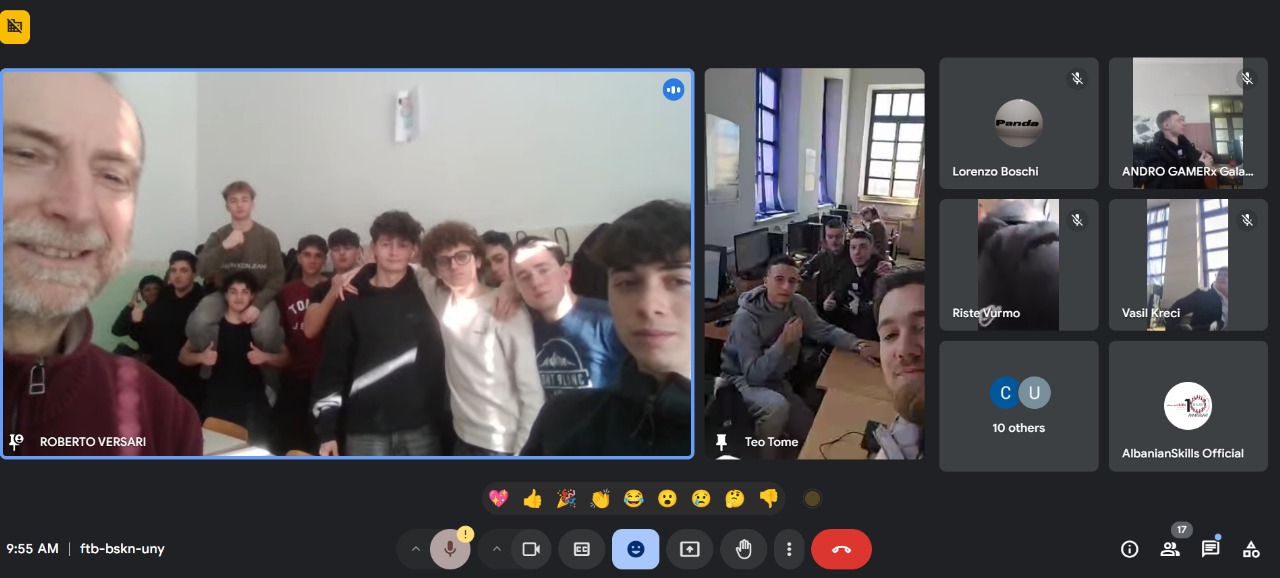
Work Package 4 (WP4) of the DC-VET WB project focuses on creating opportunities for students to gain hands-on experience and collaborate across borders. This part of the project is designed to help students develop practical skills through a mix of online and in-person learning, also known as blended mobility.
As part of WP4, students from Albania, Bosnia & Herzegovina, Finland, Italy, Kosovo, Montenegro and Spain are working together on activities related to technology, innovation and transversal skills, improving their problem-solving skills and teamwork. The program includes virtual sessions where students learn and complete assignments remotely, followed by in-person activities that allow them to apply their knowledge in real-world settings.
This blended mobility will continue until 15-19 September 2025, when students will travel to Albania for the final stage of their learning experience. During this time, they will meet in person, work on projects together, and take part in workshops designed to strengthen their skills and knowledge.
This initiative is a key step in preparing students for the future by combining digital learning with hands-on practice, helping them build both technical and teamwork abilities.
In this recent mobility program, participants from Albania from Shkolla Profesionale Teknike Korçë and Italy from ITT Marconi Forli, engaged in an enriching exchange focusing on IoT, embedded systems, and cloud-based applications. Through structured meetings, hands-on tasks, and teamwork, students explored innovative applications of technology while developing problem-solving and communication skills.
The blended mobility initiative aimed to integrate theoretical knowledge with practical implementation in the field of IoT. It involved a series of structured meetings—both online and offline—where students collaborated on different technical tasks. The key focus areas included:
- Understanding and working with MQTT communication protocols.
- Developing IoT-based projects using Arduino boards and sensors.
- Enhancing problem-solving skills through guided discussions and troubleshooting.
Before the in-person meetings, students engaged in virtual discussions, sharing reflections on challenges and solutions encountered in previous tasks. Online tools such as Kahoot quizzes were used to reinforce knowledge and encourage active participation. The students were also introduced to MQTT communication via the IoT MQTT Panel app, where they learned how to exchange messages within groups using text input and log widgets.
During the face-to-face sessions, participants worked on several practical tasks, including:
- Reading Temperature and Humidity from a DHT22 Sensor
- Using Wokwi online IDE, students created an Arduino-based project to read sensor data.
- They enhanced the project by adding a switch or pushbutton to control an LED.
- Exploring AI in Embedded Systems
- Participants reflected on whether AI could replace embedded system programmers.
- A survey was conducted to gather opinions on the future role of AI in hardware development.
- Developing MQTT-based Communication for IoT Devices
- Groups used AI-powered tools to generate firmware for an Arduino R4 WiFi board.
- They implemented a system that could publish sensor data to an MQTT broker and respond to specific commands.
The last meeting focused on consolidating learnings, sharing experiences, and addressing common issues faced during the development process. Participants engaged in discussions about debugging techniques, optimizing firmware, and improving collaboration in future projects.
The blended mobility experience provided a dynamic learning environment where students not only enhanced their technical skills but also improved their ability to work in multicultural teams. The combination of online learning with hands-on activities created a comprehensive educational experience that goes beyond traditional classroom teaching.
This initiative underscores the importance of integrating blended learning methodologies into modern education, fostering collaboration across borders while preparing students for the demands of the digital and IoT-driven world.