Bridging Barriers- Showcases of Inclusive VET Practices Across the Western Balkans
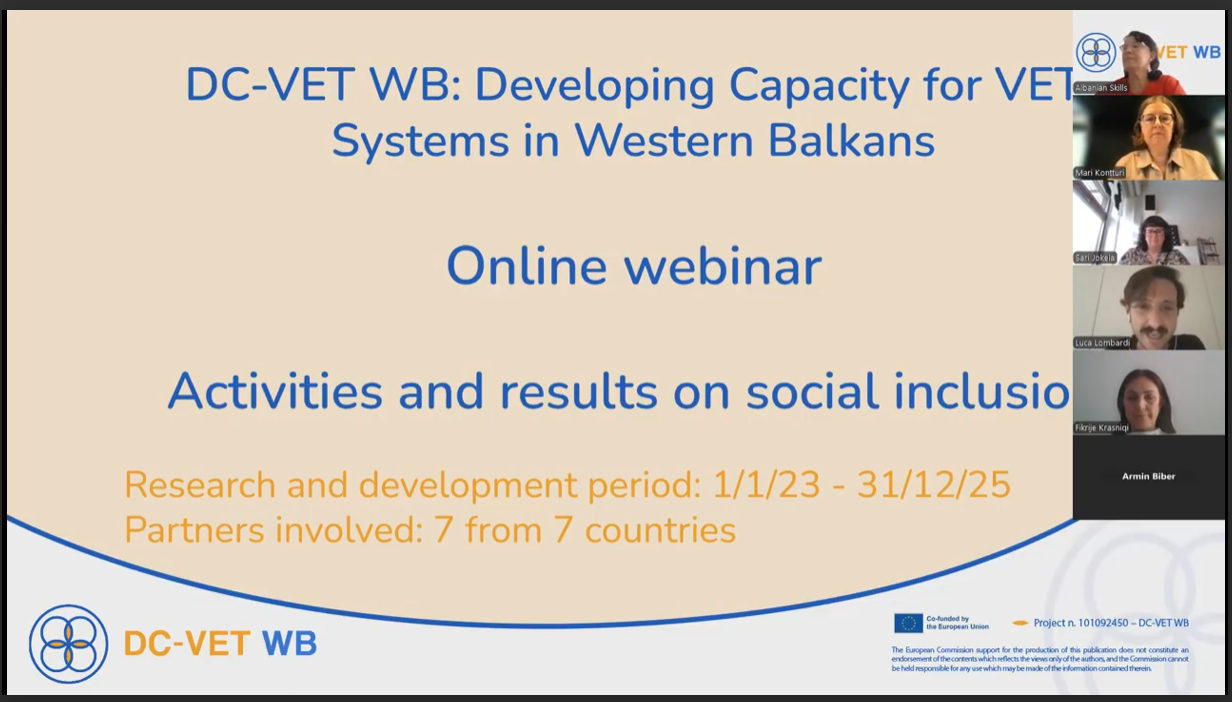
On 17 June 2025, educators and VET stakeholders from across Western Balkans and Europe came together for *”Bridging Barriers”*, an inspiring online event dedicated to inclusion in vocational education and training (VET). Hosted as part of our DC VET WB project, this session marked the launch of a new Toolkit on Social Inclusion, developed by and for VET teachers working in Albania, Bosnia and Herzegovina, Kosovo, and Montenegro.
👥 A Community Committed to Change
The event opened with welcoming words from Mr. Luca Lombardi (Uniser) and Ms. Mari Kontturi (Luovi Vocational College), who framed the gathering within the larger vision of the DC VET WB project: building stronger, more inclusive VET systems through European cooperation.
The toolkit presented during the event is not just a document—it’s a collection of real-life strategies, co-created by teachers who understand the complexities of the classroom. It’s designed to support learners who may be struggling with social, economic, health, or educational challenges, helping educators foster equity in their learning environments.
✨ Teachers at the Center
One of the most powerful parts of the session came from the teachers themselves. Educators who participated in the recent Helsinki seminar—including, Bahra Pasic (Bosnia and Herzegovina), Fikrije Krasniqi (Kosovo), and Ivana Radulović (Montenegro)—shared personal reflections, moments of insight, and practical takeaways from their study visits in Helsinki that continue to influence their daily work.
These testimonials were more than just highlights—they were reminders of the power of peer learning and international exchange in transforming teaching practice.
📊 From Vision to Action: WP3 Results
Ms. Sari Jokela (Luovi Vocational College) took the floor to present the key outputs and achievements of Work Package 3 (WP3). Her overview included both quantitative results and the qualitative impact of the project’s inclusion efforts. The newly released toolkit was celebrated as a practical outcome of months of collaboration and reflection.
🌍 Real Examples from Real Classrooms
Another highlight of the event was the Good Practices Showcase. Teachers from all four Western Balkan partner countries, Ms. Denisa Venetiku, Albania Mr. Amin Biber, Ms. Jasmina Pezo, Bosnia and Hercegovina Ms. Lindita Muja, Kosovo Ms. Ivana Radulović, Montenegro, presented real examples of inclusive teaching—from adapting methods for diverse learners to fostering belonging through community-based activities. Their stories reflected creativity, courage, and a deep commitment to making learning accessible for all.
💬 Looking Ahead: Discussion and Collaboration
The final segment of the event invited participants to reflect on what worked, how success can be sustained, and what the future might hold. The conversation, led by Ms. Sari Jokela and Ms. Mari Kontturi, brought to light a shared desire of all teachers invloved to scale good practices, strengthen regional cooperation, and keep inclusion high on the agenda.
Ms. Ana Zacharian (Albanian Skills) joined in the closing remarks, with some project activities planned in the near future and extended invitation to stay connected with the project resouces and media channels to benefit from its teaching materials and courses like VET Going International, etc, encouraging continued dialogue and collaboration beyond the life of the project.
📘 The Toolkit Is Now Available
Whether you’re a teacher, trainer, or school leader, the new DC VET WB Toolkit on Social Inclusion offers practical strategies and inspiration drawn from real experiences in VET across the Western Balkans. It’s a resource meant to be shared, adapted, and used as a springboard for further innovation in inclusive teaching.
💡 Final Thoughts
To conclude, the “Bridging Barriers” wasn’t just the name of an event—it was a clear reflection of what’s possible when educators come together across borders with a common purpose. Through the DC VET WB project, inclusion is no longer just a goal; it’s becoming a daily practice, rooted in empathy, collaboration, and courage.